pages

Showing posts with label libri. Show all posts

Sunday, 9 October 2016

One in, one out - Part II

Sometimes (most of the times, actually) movies shouldn't have a sequel: you start well, with a fairly decent movie, with normally a baddie that is more interesting than the main character and then you find yourself, 20-30 years down the line starring in a movie with some silly title like "It's too hard to die, so I'll settle for some Vodafone ads, thank you".

Without having to wait 20 years, I can report about the state of my minimalist approach to the book shelves.
The project is still ongoing, even though I wonder why, given I'm the best and worse sabotateur of my own plans.

Just like any sequel movies, the beginning of chapter 2 starts in a presumably unconsequential way: grey sky, rain drizzling down gently, our heroine is in Vienna. Life goes on as usual, and I've used a business trip as a valid excuse to try out Sacher Torte at the Sacher Hotel and visit a beautiful exhibition at Albertina on Pointillism.
The exhibition is so beautiful, that after thinking over it for a day, I’ve decided to head back to Albertina and buy the catalogue of the exhibition. Damn. It’s heavy.

Culture weighs tons. But the book is so nice, that I decide that yes, sod it, I want it, I’ll buy it.
Any sense of guilt of adding up to my collection is soothed by the notion that, before leaving home, I had already prepared a bag with 7 books to be sold. Seven books to be sold minus 1 book I was about to buy equals 6 books allowance.

I sold them yesterday: 7 books equals 16 euro.
I felt pleased with myself. "See Virgi? It's not so hard, is it?"
I felt relaxed: 7 books out, equals 16 euro and a +6 books in tolerance. I reasoned that with some well aimed lending from my sister's bookcase, 6 could be the right number to get until Christmas.

I was thinking all of this, walking in the city center, enjoying the sunshine when catastrophe hit. The main shopping street of Torino was full of book stands. I somehow forgot that Portici di Carta was planned for this weekend.

It’s an event where bookshops put stands under the colonnade of one of the main street of the city center. New books, used books, antique books. Basically a strip of temptations leading me to perdition and to the metro station.

“I can do it, I can do it. These are old new books, I can buy them in bookshops as well, no point in getting them here”. The first 200 meters were easy, but then the used books sections started and…

And I happened to see a 1937 edition of short stories by Stefan Zweig, hailed by the editor as the most interesting voice coming from the German speaking areas of Europe. It’s a bit surreal, thinking that in a couple of years things would take a turn for the worse in Austria and probably by then Zweig’s volume had already disappeared from Italian shelves, given the ’38 racial laws that were put in place by Italy.

It was just 5 euro, how could I leave it there? I didn’t obviously.
7 books minus 2 books equals 5 books and 11 euro. That’s ok, I reassured myself, just keep walking.
The end. 
nd credits roll. People leave the cinema commenting on the poorness of the sequel.
In doing so, however, they miss the bonus scene in the middle of the credits.


I knew it was going to happen. I knew that my will is as strong as a melting ice-cream, but did that stop me? No! 
7 books in the end equals to 1 book allowance and a -2 euro final balance. 

Tuesday, 23 August 2016

My summer with Natalia

It started by chance, while looking for alternative and solutions for the shelves crisis.
I found the podcast of an Italian radio program, "Ad Alta Voce" ( Out aloud); it broadcasts 5 days a week and it's all in the title: novels are read out aloud. When I subscribed to the podcast, they were halfway through Carlo Cassola's "La ragazza di Bube" (Bube's girl), read by Alessandro Benvenuti.

"La ragazza di Bube" is one of those novels you read at school. No, let me rephrase that: "La ragazza di Bube" is one of those novel you're made to read and write a paper about it.
And that's what I did: I read it and dutifully wrote a paper highlighting the main topics, the style of the writer, the historical background, etc. etc. I also dutifully avoided voicing my own opinion, because that wasn't requested, so my teacher could only suspect (if she ever cared) that I found this novel a terrible bore and the 2 main characters, Mara and Bube, quite insufferable.

So, no big surprise that, when I subscribed to the podcast, I assumed I was going to drop out of it very soon. Oddly though I didn't. I believe it's all because of Benvenuti: he's an amazing actor and his voice brought the story alive. I quickly caught up with the previous episode and every day I'd scroll the episode list to see if any update on the podcast was coming up.

Oh no, time didn't change me that much: the novel is still a terrible bore and I still find Mara and Bube insufferable.
But the podcast stuck with me. I retrieved old episodes, I kept up with new novels being broadcasted.
And then on the evening of my birthday I had some catch up to do, having been away for a small concert marathon, between Ferrara and Milano.

The kitchen window was open, kids were screaming in the street, I had just started chopping aubergines for dinner when Sandra Toffolatti started reading of "Voices of the evening" by Natalia Ginzburg.

None of my teachers at school deemed Natalia Ginzburg worth more than reading some bits and pieces contained in the Italian literature manual. I didn't have to memorize date and place of birth and death and I wasn't even asked to write a report about her. I knew about her life and her writing of course, but she just skirted on the edges of my reading, never too close to take a honest look at. And I wonder why: from the first few sentences I was hooked to the novel.

It's so well written, minimalist, many things left unwritten, many other described to the smallest details. The name, the prose, everything reminded me of my grandparents village. I enjoyed it so so much, I was sad when it finished. But the bittersweetness lasted the time of the weekend, as on Monday "The Little Virtues" started. Too much of a coincidence, right? A small research and it turns out Natalia Ginzburg was born one century ago and there was going to be a special series of "Ad Alta Voce" in her honor. 
After "Valentino", it's now the turn of "Family sayings".
It's become a sort of habit for me. I listen to it in the late afternoon, early evening: I might be lazying on the armchair, knitting, sitting on the small balcony of my bedroom, or doing some chores around the flat. I just know, I just feel it's time to listen to my daily dose of Ginzburg's prose and I happily tune in.
At that point, whatever I was doing falls into the background, most of the time I end up sitting on the floor, hugging my knees and staring at a vague spot on the floor, next to the mobile.
When the music of the piano signals the end of the episode, I regret it's over already, wishing it could have lasted 10 more minutes. Why do they have to make episode so short anyway?
But then I also wish episode could be 10 minutes shorter too, so that the reading would span for a longer number of days.
But "Family sayings" will wrap up next week and I haven't checked if some other works of Natalia will be read. Yet I know the moment they stop and Natalia will be gone, so will be my summer and I'm not ready to let go any of them.

Wednesday, 10 August 2016

One in, one out

When I moved back to Torino, one of the things I was most looking forward was the notion of my own library being finally reunited. No more books scattered around, no more digging through the shelves for a volume that is in the other city. No. Just one single and hopefully organized collection.

My dreams of shelves glory crashed almost immediately, due to a sudden and sad realization: space is not something one can ignore.
What happened is that I brought all my books back from Milano to Torino and added them to the one I already had in the flat.
Then I went down to the basement and got out the boxes of book I put there. Ok, shelves are starting to look a bit packed.
Then I went to my parents flat and brought back from there the ones I left there at different stages of my like. My mum also managed to sneak in some extra books for good measure. Ok, shelves do look way too packed, can I stack layers of book one on top of the other?
Then I discovered also my sister had books of mine in her flat and she was very keen to give them back to me, as she's running out of space too.
At that point there was only one thing to do: I went to Ikea and bought extra shelves to add on top of my book case.

Now got one shelf and half of free space, but I can't feel relaxed. It's obvious to me that, by my reading and shopping standard, it's a very tiny space. It can't last forever, but I need it to last as long as possible.
I decided to patch things up: I am trying to listen to audiobooks, reading more e-books (audiobooks are a bit more successful than e-books at the moment), going to the library.
I'm also trying to do something I've never been very good at: selling books.

As a Austen-esque Miyagi-san, I embraced a new mantra: "one in, one out". For every book I buy, one book has to be sold. For every new book I put on the shelves, an old one has to be taken off them. And possibly not be put on the bedside table or somewhere else in the flat.

So far it's going pretty well, I've got a certain number of books that, to be honest, I haven't reopened once since I finished reading them the first time. Also I've found out that I'm becoming slightly less attached to things. I'm less worried than in the past of the risk of becoming that kind of hoarder you see in TV shows, even though there are still some exceptions. For example, I still haven't decided whether the books I got for my birthday should count. And I decided that the volume of "Harry Potter and the cursed child" I somehow bought last week while waiting for the train is not really going to count. How come? Magic!

Tuesday, 5 January 2016

rediscovering Lussu

Reading Emilio Lussu’s “A Soldier on the Southern Front” is quite common in Italy. Even if you don’t, there’s a high chance you eventually read passages of it during literature classes in junior or high school.

The original title “Un anno sull’altipiano” translates as “A year on the High Plateau” and it refers to the Asiago Plateau, where World War I was fought. But somehow the new edition in English brought along a new title as well.

As for most of the books I read while growing up, I connect the book strongly to the cover. All black and white but for the title, there is a photo in the middle; 3 men, 3 soldiers in white mimetic uniforms, walking in line in a white landscape: snow on the ground, snow on the mountains, snow all around. Like many of the books I read back then, it gave me chills and feel cold.
First time I read this book, it was in a time of heavy reading of XX century Italian literature: Primo Levi, Mario Rigoni Stern, Fruttero & Lucentini and then Emilio Lussu.

Lussu’s book is the memoir of one of the years he spent fighting on the Italian front during World War I. There’s no boast of patriotic heroism, it’s a plain description of the horror and non sense of war and death in the trenches. It doesn't focus extremely on the carnage in its more visual details, but spends a lot of pages describing the utter lack of logic and moral sense behind it.

I remember the heavy sense of rage and injustice it caused in me. I was amazed and upset by the utter stupidity of war. Of that war.
Kids are not that jaded yet by the world and the people. There’s no resignation or cynicism formed yet, no idea on how to shield your conscience and guts to the blows of witnessing injustice and having no idea how or means to prevent it.
That's why, while reading “A Soldier on the Southern Front”, I got extremely angry because of many things, but above all because of General Leone. He’s one of the main characters: he’s absurd and completely crazy. Devoid of any feelings towards the human fellows that make his army, he has no problem at ordering them to run towards bloody and meaningless massacres, to battle that resoled in no gain and had no purpose in the bigger picture of the war, something that can be actually said of pretty much the whole of WWI.

General Leone is the most fitting example of incompetence, arrogance and lack of humanity of the people that decided and conducted that war. This butcher was inspired by a real person, general Giacinto Ferrero. He won several medals, and died (I presume quite peacefully and full of Catholic grace) at home, not in the massacres he ordered on the Alps and elsewhere.

I was dismayed: how? How can somebody like this man arrived at such a place of power? How could he be responsible for so many killings and yet not being held accountable for them? But at the end, he was just one of the many, not the first, not the last. And the truth is that the one that will eventually replace his is in no aspect any better than Leone, so that the men, Lussu writes, almost regret Leone being replaced.
On Monday I thought of just reading some passages while waiting for the veggies to be roasted and thought “why not? Why limit oneself to some quote from the book when I can re-read the whole of it?

And so I went on and re-read it: I found out I haven’t changed that much in all these years. The utter idiocy of men and war still drives me mad. I still had to fight the impulse of shouting profanities at the people depicted on the pages. Ugh, annoying, stupid military and politician elite.

Yet, I found out something I didn’t remember.
‘Have you ever been wounded?'
‘No, sir, general.’
‘What, you’ve been on the frontline for the entire war and you’ve never been wounded? Never?’
‘Never, general. Unless we want to consider a few flesh wounds that i’ve treated here in the battalion, without going to the hospital’
‘No, No, I’m talking about serious wounds, grave wounds.’
‘Never, general.’
‘That’s very odd. How do you explain that?’
[…]
‘Very odd indeed. Are you perhaps timorous?’
[…] The general changed the subject.
‘Do you love war?’

Or rather something I was maybe too immature to perceive back then: Lussu’s sarcasm, irony, his ability to make the reader feel how absurd wars are.
Reading Lussu again made me smile sometimes: it was a very bitter and sad smile, it didn’t make the sadness and heavy feeling go away, but added enjoyment to reading it. Can I smile and laugh of war? Yes, I think I can and I should, as it proves a good defence against desperation and being upset.
What comes out from Lussu's words is a collection of surreal people and situations and complete idiocy: I think a lot of it would fit well in some Monty Python's sketches. 

Thursday, 10 December 2015

Growing avocados

How was your long weekend?”All the colleagues I chatted to today asked me this question.

Yes”, was my answer, “Way too short".

Two national holidays one after the other meant I was coming back after 4 days away from the office and with the nice prospect of a very short working week ahead of me. Not bad!

Yet, getting back into Milan and into work proved very difficult, if feels harder at each train trip.
Ah, if only I had a penny for every single time I found myself trying to explain the reason why I hate this place so much! Summed up with the pennies I wish I had for each time somebody asked me what’s wrong with Milan and/or why my company didn’t move to Torino… Well, I think at that point I’d have enough money to stop working, retire and do something better than trying to find impossible answers to insufferable questions.

As nobody is giving me any money, I’ll try to answer the questions, just not this time, just not here, it’s something we can postpone to some better time in the future.

For now I just want to wallow in the nice feeling the memory of 4 days spent at home can give me.
I didn’t do anything spectacular or breathtaking. I went to the hairdresser: my hair took a beating by the week spent in Chengdu, as something in the water and air made my hair bleed the color dye out way too quickly and by Saturday I was the shade of a very pale cotton candy. Now I’m back to a nice punch-in-between-the-eyes, glows-in-the-dark shocking pink.
It goes extremely well with my new hat:

rikke hat


I spent times with my family. Without putting any real effort into it, my niece and the family fell into Doctor Who! My sister was even talking about getting a Dalek ringtone (I might have helped her a bit a little later on).
Because Rai is playing catch up, it’s basically running a single episode every day, so my niece is happily overdosing on it: I’m not sure about what will happen when they’ll get to the end of this season. I think it’ll be around Christmas break and at that point I’ll have a cranky 10-year-old niece with no new episode to watch… and cinemas too packed to go and watch “Star Wars”. Oh joy.
I watched Ninotchka twice, because it’s a nice movie and it was the only movie I remembered to load on the iPad on Friday (note to self: organize better for Christmas break).

Well, we're not thinking too much about it right now. At the moment the talk is about how heretical we can get the nativity scene to be this year. Oh, I know, I know: we're an atheist family, what's the point of us celebrating Christmas. Well, I'm celebrating the fact I get days off work, where I can be over-indulgent with food and alcohol without having to deal with my ghosts and paranoia.
And in the past few years watching the kids setting up the nativity scene at their grandparents have proved to be the most entertaining part of the whole holiday. My mum has recently declared she was never ever going to get the statues out, she was done, no way she was going through the whole nightmare one more time.
Three days later she was proudly showing off on FaceTime her latest contribution to the scene: she made a small shop "buy here" with some old box and she was going to place the Angry Bird Darth Vader I got her as souvenir next to it.  The nativity scene isn't complete yet, but I already spotted 2 statues that look straight out of "The Walking Dead", a blue duck with a star hanging off the neck and my sister also temporarily placed her penguin, Pinguino Gerundio, in it.

I am going back in two days, so I am pretty sure I'll see more interesting addition to the ensemble, and as long as I can remove any battery that powers nasty music boxes I'm going to be ok.

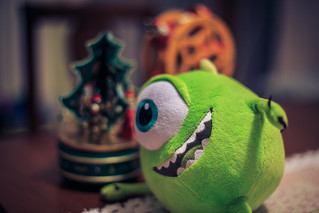
Wazowski
(2 of those nasty music boxes in the background)

I spent lot of time reading: nothing better than my armchair, some tea and whiskey and a book to finish. This weekend around it was the turn of “American Gods” by Neil Gaiman. I finished reading it yesterday on the bus: it was cold and dark. Humidity made the bus damp. I had music on, as usual, so I was in a bubble, even though not as comfortable a bubble as the one provided me by my armchair. In a way it made sense: I was sad as I could see the pages to the end becoming less and less each stop and I didn’t want to be too cozy when I was being sad.
While waiting for the bus I read this:
“Yes,” said Whiskey Jack.“‘Yes’? What kind of an answer is ‘Yes’?”“It’s a good answer. True answer, too.”
[…]
“Avocados,” agreed Whiskey Jack. “That’s them. They don’t grow up this way. This is wild rice country. Moose country. What I’m trying to say is that America is like that. It’s not good growing country for gods. They don’t grow well here. They’re like avocados trying to grow in wild rice country.” (American Gods, Neil Gaiman)
I wrote it down, in a very bad calligraphy: try to write while standing on an articulated bus speeding on some tram tracks and then tell me how good your calligraphy is.
It’s an honest answer, yes, more honest than most of the bullshit I received as answers in the past few months.
And perhaps me trying to live and be happy in Milan is just like being an avocado trying to grow in wild rice country.

Wednesday, 9 December 2015

career of evil

I didn’t know it. I couldnt know it. But sometimes things happen as they’re meant to be and that’s all I or you need to know about it. Here’s the non-linear explanation of what happened.

I started reading the Cormoran Strike’s book series by chance: I had a voucher to use and the book fitted the amount I had left, shipping included. It doesn’t happen that often so I had to buy it. As soon as I started reading it, I got hooked on it.

When the released of the third instalment of the series was announced, I preorder it: paperback edition, as the previous 2 books are paperback too and I don’t want a different format to mess with my shelves layout scheme.

It took me one week of commuting and some quiet time in the evening to finish reading it and I enjoyed it a lot. It’s entertaining and I’m a bit worried by the small note at the end of the book about a BBC series inspired by the book: what will it be like? Will I like it or hate it? I’ve got my own Cormoran and my own Robin in my mind, I’m not ready to see them on the small screen.

But then again, why being so negative? I had the same kind of doubt before watching “The No. 1 Ladies Detective Agency” and it did turn out just fine.

What I did while reading was listening to music. There’s nothing new in this: music is always on at home and when I’m wandering around by myself. But usually the music I listen to follows my mood. It might be that the book impacts my mood and, as a consequence, my choice in music too.

This time around, however, it was the book itself dictating the soundtrack. Every chapter in “Career of Evil” starts with some lyrics, all by Blue Ɩyster Cult. Well, even the title of the book comes from one of their songs, so why listening to something different? However it was not so easy as it sounds: at the beginning I thought I cuold simply follow the tracks in the order they were presented, but it didn’t work out that well.

First of all the chapters vary in lenght. Songs do that too, with the little detail that BƖC weren’t exactly famous for their radio edit versions.

So, to put it in a way a 3rd grader can understand:

“Virgi reads a chapter in 5 minutes, while the song at the beginning of the chapter last 9 minutes. How long will Virgi have to wait before moving to the next chapter and the next song? Provide examples of how she could use the time she will have on her end while patiently waiting for the song to end."

The temporary solution I found was putting the book on one side, going to the kitchen and refill the glass with San Simone.

Following chapter, I set the book on one side, went to the kitchen and brought the San Simone bottle back with me.

Five chapters later, I found out Robert Galbraith, BƖC and San Simone mix perfectly together; alas, they also result in a splitting headache and hangover the morning after.

Tuesday, 10 November 2015

Chess and Tetris

I was obsessed about Tetris. I still am, but I got better self-control on. I used to play it non-stop, borrowing a friend’s Nintendo and on our home computer, on a floppy my dad got us.
I would embark into marathons. I hit bottom rock in Beijing: no class scheduled because of the Sars-induced shut down, personal life in shatters, I started a game of Tetris. I played for about 20 hours: safe for some loo break, it was a non-stop brick after brick frenzy.

I told myself “Just one more game”.
But then I made a stupid mistake. Or beat my record.
So I told myself “Just one more game” once more and started again. I drank hot water and ate that weird supermarket bread that felt and tasted like rubber, because I had nothing left in the room.

When I finally turned the computer off and went to bed I wasn’t feeling completely myself: I could feel my heartbeat in the throat, thumping like crazy and I couldn’t breath properly. Every time I closed my eyes, colored bricks kept on appearing behind my eyelids and I had to rotate and move them to clear enough lines to keep them falling. I didn’t fall asleep easily and, when I did, I dreamt of Tetris.
When I woke up I was still very tired, still with a crazy heartbeat. Tetris brick were now everywhere: in the washroom’s mirror, in the chopsticks holder in the canteen, in the paths and ponds around Tsinghua garden.

Because of the lockdown, foreign student were extremely bored and this brought a surge in consumption of booze and pot. People all over the dorm looked quite stoned and in a perennial state of hangover (with the exceptions of the North Koreans, of course). Having just overdosed on Tetris, I fit in with the rest of the crowd so perfectly, I think I never fit with the crowd so well before, nor I ever did after.

Obsessed and high as I was, I also knew I had reached a limit with Tetris I couldn’t allow myself to go over again. The fascination with the game was (and still is) strong, but so were the alarms ringing in my head. Obsessions find a welcoming habitat in my head, my brain seems to always be waiting for the next one to come along. But right then I had a very physical reminder of the consequences: the nausea blocked my body and thought process. It took me more than two days to go back to normal; I knew I couldn’t let this obsession take over, so after that episode I didn’t play Tetris for about 3 years.

I still play Tetris nowadays, but I got strict rules: there’s no game after 10 in the evening. The Tetris app gets periodically deleted from my iPhone and it’s got to go before I’m about to go on a long trip (which reminds I need to delete it before Saturday: 18 hours of plane travel are waiting for me, I simply can’t afford to leave room to temptation).

Last month, while in London, I bought a book by Stefan Zweig.
I didn’t plan to buy (more) books and the way I justified it to Francesco sounds a bit pathetic.

“It’s only 3£. And it’s a novella, not a novel. And it’s so tiny it fits into my coat’s pocket. So it doesn’t really count as a book, does it?”
No, you’re right. It doesn’t count as a book”, said Francesco, with the kind the kind of tone a nurse of a mental word would use with one of her patients before trying to make her wear a straitjacket.
I didn’t say that I bought it because of a sign:

Chess

A small communal garden, a giant-size chess set, a match in progress. Five days later, I was at Foyles holding a small book, aptly named “Chess”: could I have left it behind it? I could have, but it'd be not very in character and I wasn't in the mood of disappointment.

It took me 2 commuting travels to finish it, but the story stayed with me for much longer. It was a discovery from many point of view.

First of all the author: how is it possible I’ve lived until today without having basically no knowledge of his work? For such great and famous writer, I couldn’t remember his name ever be mentioned during literature or German culture classes.
Secondly: how could I have watched "Grand Hotel Budapest" without ever feeling the curiosity to find out a bit more about Wes Anderson's inspiration? Zweig's life and work, everything is tragic and fascinating. Reading “Chess” made me curious about his other books.

The story takes place on a ship headed to Buenos Aires: on board a world champion of chess accepts to play for money against a group of passengers. It looks they're set to be defeated when they're helped by another passenger. The narrator then listen to this man, Dr B, recanters his story: originally from Austria, like the author, Dr B used a stolen book on chess to learn to play the game and used it as mental relief during his imprisonment by the Gestapo. But then chess, turned into an obsession: the game moved from his improvised board to an imagined one and then into his mind only. He started playing both black and white, battling his now self to a game that claimed his physical and mental health.

It’s a fascinating read, no matter the fact I can barely tell a pawn from a knight. What gripped at my soul the most is the description of how something can quickly turn from saving grace to obsession, pushing you to the brink of insanity and perhaps beyond. One could argue that Tetris, a video game, is not the same thing as chess, the Royal Game: true but, as the title of a brilliant documentary suggests, it's the ecstasy of the order. And much more than that.

The sentences Zweig used to describe how the chess matches claim the whole intellect of Dr B rang true to my eyes and ears, as I felt the same for Tetris when in Beijing. I was not in a prison, even though Beijing during the Sars was not (and still isn’t, after it) exactly the poster image of freedom. Yet I felt trapped. Tetris provided me a getaway from a physical prison, but triggered the bars that could and still can shut my brain down.

Wednesday, 23 September 2015

Lovercraft on the beach - part II

No, I didn’t read another book by Lovercraft, but because the first part of this post was named after him and because I’m too tired to go back and correct it, this will be part 2 of “Lovercraft on the beach”. And to be honest, at a certain point, I wished I had brought a second Lovercraft book with me.


One hour into the reading of “Ficciones” by Jorge Luis Borges, I texted my parents commenting about it being hopelessly heavy.

Then I went back to reading it, not before reminding myself over and over about some of the things Daniel Pennac wrote in “Comme un roman".
It’s not that I disliked completely Ficciones, but most of the time I could not understand what Borges was about. As everybody around me seems to hail him as a genius and his works as masterpieces, I once again endulged myself in one of my (apparently) favorite hobby: doubting my own intellect, taste in book and ability of understanding. Cause clearly I’m not on the same level of all these people that (apparently) understaood this book. And I’d be okay not to understanding it, as long as I could say I enjoyed reading it. But it was such a frustrating experience!

I kept peeking at the number of pages left in the story I was reading, while promising myself “Next one will be better. Next one will be better."

The problem is that it never got that much better. That’s when “Comme un roman” came in handy: in it, Pennac states that the second right of the reader is the right ot skip and the third one is to not finish a book. It can be. It’s not that a matter of lacking understanding, more a question of personal taste and there’s nothing bad or shameful in it. The reassurance of my rights and some heavy skipping allowed me finish the book, even though I have no clue of what it was all about.

And it also allowed me to have some nice naps during my reading.

Sunday, 20 September 2015

Lovercraft on the beach - part I

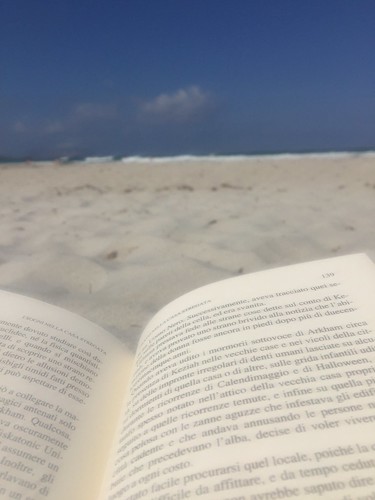
In spiaggia
Lovercraft and the power of sun cream to enhance photography

The first thing I put in the suitcase were the books. Then the knitting projects.

What can I say? No matter the defects I have as individual, when it comes to packing I got my priorities straight.

So, armed with 4 books and 2 1/2 knitting project I felt quite ready for the holidays and only later asked myself: “what else should I pack?"

Ah yeah, all the rest, like swimming costumes, clothes, sun creams and whatever else it’s needed for 2 weeks at the seaside! But, after all, that’s what last minute preparation is for, right?

To start my holiday on a light note, I put Lovercraft’s short stories collection in the carry-on bag. It wasn’t planned, more of a very last minute impulsive shopping. Saturday before leaving I saw this book being sold for 3,9 euro.


— Note: here’s a small detour-rant on the topic of price tagging —

The price tag has a gigantic bold 3, while the “,90” bit is printed at almost micron font size, giving you the impression that the cost of the book is only 3€ rather than 4. And you might say: well, it’s only 4€, what’s the problem with you?

The problem is not the price itself, but rother it is printed to trick your mind into believing it’s 3 rather than 4. I wouldn’t get upset if all the digits were the same size or if the decimal digits didn’t require a magnifying lens to be read. Just be fair and state the price without subterfuge. Also, becuase this is the kind of purchase I use as a way of getting rid of all my pocket change, and I don’t enjoy to realize when I’m about the front of the queue that I don’t have the exact change. Damn! It means I have to scavange hunt for the remaining 90 cents, while the queue of Milanese customers growing restless and upset. Have you ever seen a Milanese person forced to wait because the person in front in the line is obviously hopeless and clumsy? In case you haven’t, call yourself lucky: they do love to make you feel like the lowest form of life ever to walk the earth.

So genius of marketing make the genius move of advertising the right prize on the book front cover.

— End of rant, oh I feel so much better now —


Now, back to Lovercraft: I briefly debated whether or not to buy the book, as I’m already running low on shelf space and anyway I would have to wait to be back from holiday to start reading the book.

The shelf space issue was immediately resolved with the idea of visiting Ikea again over the autumn and as for waiting for starting reading the book, then notion laster around 150 mt, the distance from the book shop to the bus stop. As I ended up halfway through the second story, I had no other option but carrying it with me.

Lovercraft makes for a weird summer read, because of the sharp contrast between the stories themes and styles, mainly set in cold months and the sun beating down, the blue sky and the quiet Sardinian sea. Yet, it seemed to me that the contrast accelerated my reading because I was done in less than 2 days, which is even more astounding given that on the first few days of holiday i slept most of the time.

Second book to go for sand bath treatments (the sand was so thin it managed to get everywhere and I fear the books I brought with me will spit sand out for the next 12 months) was “Justinian’s Flea” by William Rosen. What better way to spend a day at the sea with a lot of minuscule forms of life than reading of the devastating effects of Yersinia pestis on the Roman Empire?

Because the author is neither a scientist nor a historian, he offers a different approach; yet, since he worked in publishing houses for many years, he knew he had to do his homework when it came to bibliography and researches for the book.

Reading about history is fascinating to me because it’s like watching a domino show: you can concentrate on a single tile if you want but you risk of missing the whole effect. On the other hand, if you just look at the show as a whole, you miss the fine details and the importance of how and where tiles are placed. It’s a tough job to write about history, because aside the big and small picture, the writers should also make it nice to read: it’s not an easy task altogether as most of my high school and Univeristy history text can prove.

When I bought the book I was more interest in the Roman history side but the part I “enjoyed" more was the 3rd section of the book where Morris goes over in great details about the (hi)story of the bacterium: I’m not really interested in microbiology, but the fact that in the boot it’s put into a narrative way, it makes for a brilliant read and I found I could easily visualize how the bacterium work. It’s an horror I found more scaring than Lovercraft.

Saturday, 5 September 2015

Ode to Mrs. Spears

Thanks to Gisella’s comments on my previous post, I’ve remembered one more reason I wanted to blog about “Death at Broadcasting House”: Inspector Spears’ wife.
She appears in only one chapter, not that many pages altogether.
Yet, like all the other major and minor characters of the novel, she seems to gain a life of her own out of the pages.

Now I can’t really tell how the authors wanted her to come across to readers, but that’s one of the most fascinating part of reading rights? Writers create the characters, yet it’s up to their readers to truly bring them to life.

To me, Mrs. Madge Spears is amazing. To my eyes and imagination, she’s the kind of woman smarter than what society around her and its convention allowed her to be and to show to other people.
She deeply knows her husband: she knows how to defuse his bad mood, while still allowing him his space for thinking about his investigation; she’s able to help him to untangle part of his idea about the murder while, at the same time, keeping up with her knitting.

Yep, with an explosive and popping “p” at the end. You read it well: knitting.

Mrs. Spears is a knitter!
Is it fair to say I might be biased towards her because she’s a knitter?
Hell yeah, I am! I’m very biased but who cares?

The thing I truly love about her description in the book is that it’s very vivid, honest, close to real knitter in real life.

Traditionally knitting in crime fiction is associated to Miss Marple, the clever, old spinster knitting while solving mysteries. I also tried to read some knitting-related novels "The Friday Night Knitting Club” but ended up hating it, as it’s not my genre at all (and it’s poorly written too).

But Madge Spears is different: she’s real, I can picture her in my mind.
She appears to me in a ’30s dress and haircut, her hands cured but not perfect because she still takes care of all the house chores. She wears a faint lipstick and in my head she has a sincere and witty smile. I bet she’s patient and wise but I also believe she’s a olympic champion at eyebrow arching.
I can see her sitting next to her husband, letting him talk about what’s bothering about the whole matter, while she picks up her knitting, an emerald green sweater, a color she picked because she knows it’s Simon’s favorite.

The deductions of Inspector Spears keep the rhythm set by the clicking of his wife’s knitting needles and she keeps knitting while asking questions and allowing Spears (and his writers) to discuss possible motives and suspects of the murder.
And she’s so engrossed by the whole matter that at one point she does something every knitter did once: she drops a stitch. And it’s hilarious and smart to read how the knitting and the analysis of the murder end up in one single line.

"Bother," said Madge. "I've dropped a stitch. Would the murderer know that?"

When I read this line I was on the metro back home and I missed my stop, as I was giggly and euphoric. You might think this is not a reason good enough to read the book or make a new movie out of it, but trust me on this: you’re wrong. :-)

Friday, 4 September 2015

Dachshunds, books and knitting

The bookshop "Mercurio" is one of my favorite spot in Torino: I was really amazed by it when it opened, many years ago by now.

"What? Opened till midnight? Seriously!?!?"

Nowadays we're used to shops being always open, to supermarket working 24/7 but this was different: it was a time when shops being opened on a Sunday afternoon were one-off special events and, there it was, a shop open until late, a shop open when all the other shops were closed.

And above all it wasn't a chain store, but an independent shop. And it was an independent book shop!
You might think it's a small shop but that's an illusion: once you step in you realize how wrong you are; down the rabbit hole there's a corridor, stuck with books on one side and cards, postcards and other stationery on the opposite wall, and at the end of it there is another room. Then, at the end of the room a set of stairs takes you upstairs. Or you can turn right into the other room for kids literature.

There are many things I love about Mercurio: the fact that the booksellers know about books is a winning factor. I stopped taking for granted the knowledge of booksellers when, in a big chain bookstore branch, the shop assistant asked me how to spell Stephen King.
I like that they store books that are not so easy to find in other bookstores, like books about sewing patterns or about Japanese anime. They have a massive stack of photography books, a small but heavyweight section dedicated to Torino, the standard set of classics, travel guide, popular paperback and then they always got something on offer.

I never purposely plan to go and visit the shop, yet, every time I'm in town, I somehow find myself turning into via Po from Piazza Castello thinking that "Oh well, I got up to here anyway and it's less than 50 meters away... Let's go and have a look at Mercurio"

And that's exactly what happened about 1 month ago. I was looking for a book for a friend, but my attention got completely sidetracked by a big display of a book series by a publishing house I (shamefully so) never heard of before, Polillo Editore: the covers were all salmon pink and the name of the series is "I bassotti" (The dachshunds). I found hte name of the collection and its logo so cute, I didn’t really stop to wonder why they linked this dog to a collection of crime fiction, but at that moment I couldn’t really be bothered by it. There was a whole array of books with a special price tag flashing in front of me and the first title my eyes fell on to was Freeman Wills Crofts’s “The 12:30 from Croydon
Croydon! There’s something more than Ikea in Croydon, I know... and I know that one of those things is the airport (I remember watching a documetary about it).

Not so long story even shorter, I bought the novel and ready it in less than a week. I just couldn’t put the book down. The inverted detective story and the translation just got me hooked and made me miss my metro stop more than once.

I once more found myself by pure chance in front of Mercurio on my next visit back home. Pure chance, nothing planned, but well… I was there already, why not going in to check if the offer on Bassotti was still going on? Yeah!

I just wanted to have a look at the bookshope once more, what’s wrong with it? What’s wrong is the fact that I’m not a big fan of crime fiction unless it’s from the golden age of crime fiction and “ I bassotti” is a book series focused solely on American and British novel from the golden age of crime fiction.
So, I was not that surprised I left the bookshop with a new book in my bag, “Death at Broadcasting House” by Val Gielguld and Holt Marvel.
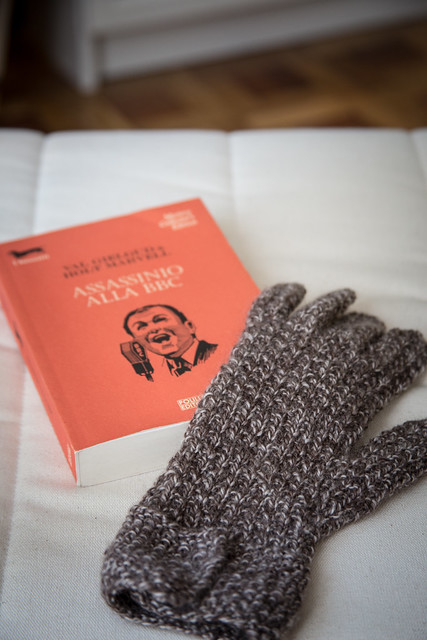
It took me a bit longer to finish this one, because I was trying to finish knitting a pair of gloves. And because (spoiler alert!) a pair of gloves plays a big part in this novel, it seemed like a sign that I should continue knitting and reading at the same time.
Well, it’s not easy: it’s very complicated; knitting and reading are not the best pair of activities you want to try for multitasking.
At the end of it, I finished reading the novel, finished one of the gloves, and learnt how to turn pages using my right foot (still debating whether adding it as skill on Lindkedin: curious how many people will endorse me for it). I've also learnt that the consequent backache is not an experience I want to repeat in the near future.

glove & book


I finished the book this week and I already miss it: the things I enjoyed the most are how smoothly it flows, the description of the characters and the description of a London that is no more. I used to work in Soho, my beloved tattoo shop is in Soho and it is so fascinating to read of an area htat I know but not that has changed so dramatically since the time the book was written.
I think that authors being so knowledgeable about how BBC worked at the time helped them a lot.
I found myself wishing a movie could be made out of it, because in my head I could picture contemporary actors in the different roles, yet at the same time being afraid of it, because I don’t really want this small universe I built inside my head to be crushed by the constraints imposed by modern movie productions on screenplay and directorial choices.
I was very happy (and relieved) to find out that a movie was actually made out of the novel the same year the book was published. Moreover Val Gielgud plays one of the main character.
And guess what? It’s available on DVD...